YEA Lesson Library
The Blind Man Can See
About This Lesson
This lesson teaches about Jesus healing the blind man.
Scriptures
Matthew 4:23-24
Matthew 9:12; 27-29
Matthew 11:4-5; 15:30-31
Mark 6:56
John 9:1-12
John 9:25
Ephesians 1:18
Words to Know
BLIND - not able to see
HEAL - to make well or healthy again
SILOAM - a spring and pool outside Jerusalem
Daily Devotions
Sunday - Ephesians 1:18
Monday - Matthew 11:4-5
Tuesday - Matthew 15:30-31
Wednesday - Matthew 4:23-24
Thursday - Matthew 9:12
Friday - Mark 6:56
Saturday - Matthew 9:27-29
YEAH — At-Home Activity
1. Seven-Up. Start class by playing a game called Seven Up. If you have a large class, choose seven people to be “it.” (If you have a smaller class, scale it down and call it Three Up.) Everyone hides their eyes with their thumb out in front of them. Each if the “it” students touches one person’s thumb and then reassembles in the front of the room. The students whose thumbs were touched try to guess who touched their thumb. Play a couple of rounds, then talk about how they might have been able to figure out who touched their thumbs. Imagine if you were blind all the time. That would be very hard. Use this as a springboard into teaching the lesson using the legacy format. (The teacher’s edition is very good.)
2. Draw It. After reading the lesson/telling the story with the students, give them 11 x 17 sheets of sketch paper. Let them choose their favorite coloring tools to draw a picture of the blind man seeing. When they are finished, have them share with each other. Write their memory verse with a sharpie along the bottom of the page.
3. Gratitude. After reading the story/telling the story with the students, help them write down a list of things that they are very grateful they can see. Write the words large, small, sideways, slanted, with small letters, capital letters, calligraphy, etc. (Since most of the students this age are non-writers, you’ll need some extra helpers if you have a large class.) Then let the students color around the words to make a pleasing reminder to be thankful for our vision!!
4. Touch Box. Construct a touch box using a shoe box (or a box of similar size and shape). Cut a round hole in one end. Put a handkerchief or other cloth over the hole. Tape or staple it to the top of the side where the hole was cut. Inside the box, put a collection of things: toy car, ball, hairbrush, comb, toothbrush, marble, small toy, etc. Let each student stick their hand into the box to see if they can tell what everything is. They are not allowed to say what’s in the box until everyone has a chance to feel. Then go around the room and ask them to name of thing they felt. Then read the lesson/tell the story with the students. After discussing how amazing it would have been for the blind man to see, open the box and let the student see what was in the box. Remind them to be grateful to God for the gift of sight.
5. Door hangers. Read the lesson/tell the story with the students. Then help them construct door hangers. (You can get foam or wooden ones at a craft store. Or you can make your own prior to class out of cardstock.)
• Foam: Write, with a sharpie, the memory verse on one side and “Pray” on the other side of the door hanger. (You may also choose to simply write the student’s name on the other side.) Then let the students decorate it with stickers. Most of this you can do prior to class. The rest of class time can be used to talk about prayers. Sometimes God says yes; sometimes God says wait; sometimes God says no - not in this life.
• Wooden: Paint with tempera paint. They students can only do one side at a time. So do one side, then tell them lesson. Enough time may have passed they can then paint the other side. Then you can write the memory verse on one side and “Pray” on the other side. You’ll want to choose wooden door hangers only if you have plenty of time to let them dry!
• Cardstock: Let the students use markers, crayons, or colored pencils to decorate each side. Then write the memory verse on one side and “pray” on the other.
Objectives
At the end of this lesson, students will be able to:
1. Describe how Jesus made the blind man see.
2. Repeat that Jesus has power to heal the sick today.
3. State what they should do when they are sick.
4. Recite their memory verse.
Topics & Themes
Blindness
Faith
Jesus, His Ministry
Jesus, His Miracles
Healing
Obedience
Physical Infirmities -
Blindness
Pool of Siloam
Poverty/Beggars
Materials Needed
Bible, YEA Students’ and Teacher’s books, attendance and memory verse charts, stars, modeling clay, a small jar of mud, bottle of aspirin or Tylenol, thermometer, cough medicine, band-aid, “pin the tail on the donkey” game and blindfold, songbook, CD, CD player
Preparation
Creativity, variety, and making learning fun are essential in keeping the attention of this age group. At the same time, they are more comfortable if a similar routine is followed each week so they will know what to expect. It is good to es- tablish areas where certain activities take place. Play, learning, activity, and eating areas should all be designated. Some of these may take place in the same area if your space is limited.
Preschoolers don’t yet understand that God provides for their needs. They assume that their parents or someone will always be there to take care of them. This week’s lesson is one more step in helping them to learn that God loves them and can heal them when they are sick because God is all powerful. Sometimes, however, God doesn’t heal. Sometimes God does allow people to have long-term illnesses, like asthma. The children need to know that isn’t a sign that God doesn’t love them. Trusting God even through an illness is very pleasing to Him.
As the children arrive, involve them in a game of “pin the tail on the donkey.” Ask: Can you see anything with the blindfold on? Explain that this is what it is like to be blind—you can’t see.
You will need a small jar of ordinary mud. Place a small amount of dirt in your jar and add a little water to make a mud paste.
Review Questions
Repetition is a good way to learn and review the lesson. Say each statement slowly and have kids repeat after you, doing the same things that you do. This could be repeated several times.
1. The blind man could not see. (Put your hands over your eyes.)
2. He couldn’t see the trees or the grass. (Reach up and then bend down.)
3. Jesus healed the blind man. (Put your hands over your eyes and take hands off.)
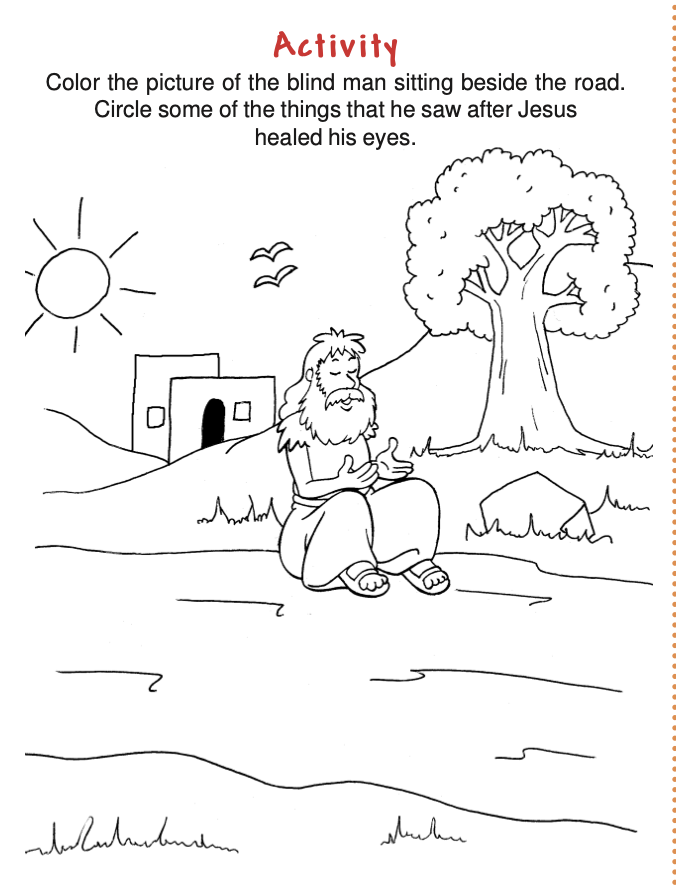
4. Now he can see the sun shine. (Make a big circle by putting your fingertips together.)
5. Now he can see the squirrel climb the tree. (Make climbing motion with your hands.)
6. Jesus is our very best friend. (Hug yourself.)
Teacher-Directed Activity
Give each child a piece of modeling clay. Ask them to make something that the blind man could see after Jesus healed his eyes.
REACH Activity
Letter: P
Words: poor, power, pool, people, put, pray
Sentence:
JESUS HAD THE POWER TO HELP THE POOR BLIND MAN SEE. HE SPIT ON THE DIRT FROM THE POOL OF SILOAM. PRAISE GOD!
Song
“O Be Careful Little Eyes” is on page 39 of the Kids Classics Collection.
Closing Prayer
Heavenly Father, Thank you for helping the blind man. Thank you that you can heal me when I am sick. Help me to always believe and obey you. In Jesus’ name I pray. Amen.
Printable Pages