YEA Lesson Library
Food For Everyone
About This Lesson
The lesson teaches Jesus’ miracle of the feeding of the 5000 after a boy shared his lunch of 2 fish and 5 loaves.
Scriptures
Psalm 37:25
Psalm 136:25-26
Matthew 6:26
Matthew 14:13-21
Mark 6:32-44
Luke 9:10-17
John 6:1-14
John 6:11
1 Timothy 6:6-8
Words to Know
MIRACLE - something that God does that man cannot do
SHARING - giving a part of what belongs to you to someone else
GIVING THANKS - praying to thank God for the food
Daily Devotions
Sunday - Psalm 37:25
Monday - Mark 6:32-33 T
uesday - Matthew 6:26
Wednesday - Matthew 14:13-21
Thursday - Luke 9:10-17
Friday - Psalm 136:25-26
Saturday 1 Timothy 6:6-8
YEAH — At-Home Activity
1. How Many Beans? Count out 5000 pinto beans. Pour them out on a table. The visual/tactile reminder of how many people Jesus fed is a nice springboard into telling the story of Jesus feeding the 5000. (You may choose to read the lesson if you’re not comfortable telling the story.)
2. Are You Hungry? Place a small loaf of bread (preferably warm and homemade) on the table before the students. The smell of fresh, warm bread will make a huge impression. (Perhaps you can use a microwave to heat the bread or a hot plate to keep it warm. In some situations, this is just not possible.) Tell the story of Jesus feeding the 5000. (You may choose to read the lesson instead.) Discuss the generosity of the small boy in sharing his lunch with Jesus. Talk about the miracle - one small lunch would not go very far in feeding 5000 people. Jesus, of course, makes all the difference.
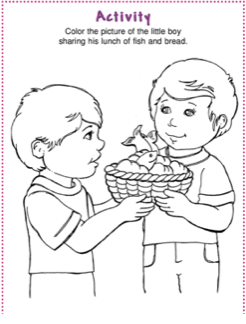
3. Sharing. Give one student a pile of construction paper, one student a container of crayons, one student several blunt-end scissors, and another student a bottle of glue. Talk about how sharing what we have with others makes us all more productive. Because each student has something he can share with the group, it makes sense to work together. But in the feeding of the 5000, it was just one small boy’s lunch. Most people wouldn’t want to share under those conditions. But Jesus took what he offered and not only fed the whole crowd, there were 12 basketfuls left over. Commend the students who are willing to share, generously, easily. Tell the story/read the lesson. Then let the students use the art supplies to draw/color a picture of the lesson.
4. Following Jesus. Like Mary Poppins’ bag, pull out a collection of items you’d want to take with you if you were going out for a couple of days: your phone, a map, a bottle of water, snacks (crackers, apples, carrots?), a blanket, a jacket, a hat, your Bible. Allow the students to make other logical suggestions. Then tell the students that this group of people were so intent on following Jesus, they didn’t bring anything with them - not even food. Tell the story of Jesus feeding the 5000 or read the lesson.
5. A Good Steward. Bring a small container and a large container of some food item (fish crackers, blueberries, cherry tomatoes) to class. If you don’t want to use food, bring a small envelope of stickers, buttons, marbles, superballs - and a large amount tucked away in your bag where the students can’t see them initially. Talk about how if you have a small amount of something, you tend to be very careful with it. You might count out the small number of fish crackers or stickers to each child. But if you have a large amount, you might just let everyone take what they want. And if there are leftovers, you might not worry about them. Read the lesson or tell the story of Jesus feeding the 5000. Then ask the students what Jesus told them to do with the leftovers. Emphasize that regardless of having a limited amount or an abundance, God expects us to be good stewards of what He puts into our care. Don’t let anything go to waste. (This might be a good time to point out that we don’t want to waste food at potluck. It’s okay to take what you want to eat, but don’t take a whole plateful and then throw it away. You can ask the students to tell you what a better approach might be, i.e. take a little bit and if you like it and you are still hungry, go back for more.)
Objectives
At the end of this lesson, students will be able to:
1. Describe the food that Jesus used to feed the crowd.
2. Explain that feeding the crowd was a miracle.
3. Tell the importance of sharing what we have with others.
4. Recite their memory verse.
Topics & Themes
Bread/loaves
Fish
Giving Thanks to God
God’s Provision
Helping Others
Jesus, His Ministry
Jesus, His Miracles
Feeding of 5000
Sacrifice and Offerings to God
Stewardship
Materials Needed
Bible, YEA Students’ and Teacher’s books, attendance and memory verse charts, stars, small basket, loaf of French bread, jelly or peanut butter, paper towels, table knife, fish-shaped crackers, something to drink, small paper cups, crayons, songbook, CD, CD player
Preparation
A preschooler’s concept of love is limited to personal experiences. They are hands-on little people who learn from what they taste, smell, see, and hear. They learn from the parent or teacher who shows love in ways that appeal to their senses.
Giving big hugs or taking care of a skinned knee means a lot to a young child. God’s love is shown to a child through your acts of kindness. These acts of kindness can include mentioning how much absent students are missed before the prayer. You can also show your love while working with short attention spans.
The idea of sharing is not within the cognitive skills of many young preschoolers. They simply understand that they must give away something that they have. Or, they may demand that someone else gives some- thing to them. Today’s lesson shows a young boy giving his lunch to Jesus so that others may have something to eat, too. The little boy was being kind and generous. He wanted to please Jesus and help others. These are concepts preschoolers can grasp.
Place a napkin inside a small basket. Lay a loaf of French bread inside the basket, along with enough fish-shaped crackers for each child to have two.
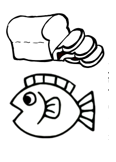
Enlarge and duplicate the fish and bread pattern onto colored construction paper. (Tan for the bread, green for the fish.) You will need five loaves and two fish. Cut out the shapes and place them in a small basket.
Review Questions
1. Where did the people follow Jesus to when He went to spend time alone with His disciples?
2. Were there a few people or many people?
3. Why didn’t the disciples go to the store to buy food?
4. Who gave Jesus his lunch?
5. What was in the little boy’s lunch? (Have children count the five loaves and two fish.)
6. What did Jesus do with the lunch?
7. How much was left over?
Teacher-Directed Activity
Place a paper towel in front of each child. Tell them to bow their heads and fold their hands. Ask the blessing for the food they are about to eat. Break the bread into pieces so that each child will have some. (This will illustrate Jesus breaking the bread.) Spread a little jam or peanut butter on each piece of bread. Tell the children you are going to share your lunch with them. Pass the basket of bread and allow each child to take out a piece. Give each child two fish-shaped crackers and something to drink. This might be a good time to start a food drive to help needy people in your community or church. The children could help with collecting canned goods to share with someone else.
REACH Activity
Letter: F
Words: fish, food, follow, five, feed, fill
Sentence: FIVE LOAVES OF BREAD AND TWO SMALL FISHES FED ALL OF THE PEOPLE. THEY EVEN HAD LEFTOVERS! JESUS IS OUR FRIEND!
Song
“My God is So Big” is on page 14 of the Kids Classics Collection.
Closing Prayer
Thank you, Father, for our Friend, Jesus. Thank you for the little boy who shared his food with the hungry people. Thank you for the food we are about to eat. Please bless this food. Help us to always share what we have with others. In Jesus’ name I pray. Amen.
Printable Pages